

THANK YOU FOR SUBSCRIBING

Pharma Tech Outlook Weekly Brief
Be first to read the latest tech news, Industry Leader's Insights, and CIO interviews of medium and large enterprises exclusively from Pharma Tech Outlook
A featured contribution from Leadership Perspectives: a curated forum reserved for leaders nominated by our subscribers and vetted by our Pharma Tech Outlook APAC Advisory Board.

Our industry is being faced with pressure to develop more innovative medicine at lower cost and accelerated speeds. Being able to adjust to these pressures may mean that we need to rethink how we are organised. In this article I argue that there is an alternative way of thinking about how we are organised, and outline a way to apply this thinking to your company.
Pharmaceutical companies are still mostly organised according to functions, grouping people with similar skill sets in the same departments. This supports a waterfall approach to drug development, where one function completes an assignment and hands it off to the business function next in the value chain. According to Christian Born Djurhuus, this approach may no longer work. Let’s take a ride in a helicopter, and consider what a pharmaceutical company looks like from the highest possible level.
Five key Value Streams:
Instead of grouping activities according to professional skill sets, we can get inspired by Lean Value Stream thinking and consider what are the overarching value streams in a Pharmaceutical company.
I would argue that any pharmaceutical company or biotech can be divided into the five key Value Streams outlined in Figure above:
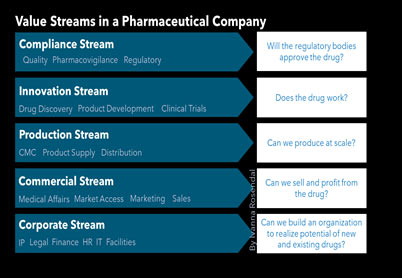 The figure shows value streams on the left hand side, with examples of departments that may fall into these. Each value stream answers a key question to a specific set of stakeholders in the industry.
For example the Innovation Value Stream answers the question “Does the drug work?” and the Compliance Value Stream answers the question of “will the regulatory bodies approve the drug?” Remove one of these value streams, and you no longer have an integrated pharmaceutical company. Fail to answer one of these questions, and the company will struggle to develop and launch a drug successfully.
“A pharmaceutical company is set out to accomplish, and avoid replicating the default organisational model that we may all have experienced in large pharmaceutical companies”
Understanding the overarching streams in a company helps inform our thinking about what a pharmaceutical company is set out to accomplish, and avoid replicating the default organisational model that we may all have experienced in large pharmaceutical companies. This is a change in how we think about our companies. But to be actionable, we need to get more specific.
Mapping out Value Creation
To apply the value stream thinking to your organisation, I suggest considering what kind of value your organisation creates at a more detailed level. In order to get to that value, it helps to think through who the recipients of that value are. Think through your key stakeholders such as regulatory bodies, shareholders, pricing agencies, patients, caregivers, HCPs and so on, and think about what value you deliver to each stakeholder group.
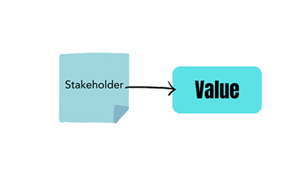
For example, a typical value could be “drug ready for human trials” completing the early research value stream, or “drug approved for reimbursement” completing the market access value stream. Having defined the value creation that is specific to your company, you can proceed by mapping out the individual high-level steps to get to that value, illustrated in figure :
To get to the value “drug approved for reimbursement” the high-level steps could include:
1. Create a comparative analysis to similar drugs in the market
2. Acquire data to complete your model
3. Create your model
4. Submit your model to the reimbursement agency
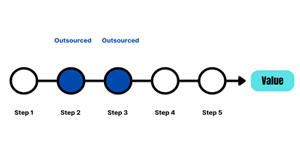 The trick is to stay as high-level as possible, and not get down into the actual delivery of the work. That is a matter for process descriptions, not organisational modelling. While you are creating these steps, think about who would deliver this work. Do you have in-house capabilities or will you be partnering with a vendor to complete this work? Making this visible can help you make smart choices on where to build capabilities and where to outsource.
Complete this detailed mapping for each high level value you have identified per stakeholder group. Each stream should have 5-7 steps maximum. If you have more, you might want to consider if you can zoom out a little bit further.
Map your activity streams to your departments
Once you understand what activity streams lead to value in your organisation, it is time to think about how you are currently organised. List through the departments that you have, and map out the steps in your activity streams to your departments. What defines a department in your case can vary. You can consider your senior leadership and which areas they cover - or perhaps you might need to go a step deeper to identify meaningful organisational units. It will help if you think about where the work is actually done. It will end up looking something like Figure 4 below:
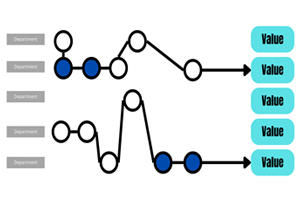
This final map will give you an invaluable overview of how work actually flows towards value. You may be surprised by how tangled the activity streams are, and how many times activities go back and forth between departments before reaching their final stage. You may even find that some work flows backwards and loops around before proceeding.
Using this map you can start thinking about how you could organise your company to support value creation instead of functional groupings. Perhaps you would consider organising yourself according to product lines or projects. Perhaps you can see that two departments work so closely together, that it might be worth collapsing them into one.
Re-thinking how you are organised and aligning it with how value is created in your company will equip you to find your way towards accelerating your drug development, unleashing innovation by bringing different perspectives together and in turn lower the cost of the drugs you create.
About The Author:
Ivanna M. Rosendal is the senior director of IT in Ascendis Pharma. She is a behavioral economist and has held technology leadership positions in life sciences for the past 12 years. She hosts a podcast about innovation in clinical trials called Transformation in Trials and writes about femtech wearables for TechTruster. She is also the author of the book Maneuvering Monday, that is currently available as a podcast. Reach out to Ivanna via LinkedIn.
