

THANK YOU FOR SUBSCRIBING

Pharma Tech Outlook Weekly Brief
Be first to read the latest tech news, Industry Leader's Insights, and CIO interviews of medium and large enterprises exclusively from Pharma Tech Outlook
A featured contribution from Leadership Perspectives: a curated forum reserved for leaders nominated by our subscribers and vetted by our Pharma Tech Outlook APAC Advisory Board.

If you are a technology enthusiast like me, you have probably read and heard that AI (artificial intelligence) is going to change our lives, our way of working, and the whole world. But how exactly is AI going to change our discipline which works with chemical and/or biological substances? Let us indulge our imagination a little and entertain the possibilities of how AI can change the field of bioanalysis. This will in turn give us some food for thought on how AI could change related fields.
AI for bioanalysis is narrow AI
Many people only think of AI as AGI (Artificial General Intelligence), or human-level intelligence. But AGI is actually the long-term goal, although in recent years it is gaining steam. Current mainstream AI is narrow AI that focuses on specific sub-problems where AI can produce verifiable commercial applications, e.g. smart search engines, self-driving cars, etc. AI for bioanalysis obviously falls into the narrow AI category. AI sub-fields that could potentially revolutionize bioanalysis include but are not limited to reasoning, problem-solving, planning and decision-making, natural language processing, perception, and advanced robotics.
Bioanalysis extracts quantitative information about the substances of our interests (drugs, targets, biomarkers, etc.) out of biological systems. In other words, it works at the boundaries between real world space and data space. Thus, when talking about AI for bioanalysis, it will have as much to do with the intelligence in manipulating real world substances, i.e., smart experiments, as with the intelligence in processing the data acquired. Typical bioanalytical work streams fall into three main categories:
● Methodology (method development, method validation, cross-validation)
● Sample testing production (sample extraction, instrumental analysis, data processing)
● Peripheral support activities (plan writing, report writing, sample logistics, QC/QA, etc.)
The above data processing and peripheral support activities take data (symbols and rules) as input and output data in the form of documents, knowledge, etc. and thus essentially operate in the digital world. Operating in the digital world is native to AI programs. Overall, scientific document writing is mostly factual, follows certain pre-defined formats and doesn’t need generative AI such as ChatGPT. Already there are software companies working on automating document writing. AI could “touch up” the documents with natural language processing prowess and make the report language flow better, while leaving the scientific data intact, which scientists insist upon. Human is still the ultimate quality controller of AI-produced scientific writings and AI QC/QA’ed data.
"The more experienced the scientists, the better the assay starting conditions and the quicker the assay optimization"
AI enhancement for bioanalytical sample extraction
A decade ago, there was already extensive research to automate the majority of small molecule bioanalytical sample preparation on commercial general purpose liquid handling robots using a combination of in-house developed software and scripting on the robots. The idea was to take user input about a sample extraction experiment and compute a complete liquid handling scheme for the experiment, then carry out the experiment using the pre-computed scheme. With the current advancement of AI, the following areas of that system could use some enhancement:
1. Merge of bioanalytical-specific user interface with robot internal scripting.
2. Integration of peripheral lab instruments, such as capper and decapper, plate sealer, vacuum, and centrifuge, both hardware and software wise to reduce human intervention during experiments.
3. AI natural language processing agent to translate a list of assay procedures in ELN (electronic lab notebook) into robotic sequences.
4. AI decision agent for the volume of calibrators and QCs to prepare for a particular batch run – decide on the fly how much volume of calibrators and QCs are needed, calculate/plan a preparation scheme and execute accordingly.
AI problem-solving agent for intelligent adjustment of dilutions – e.g. when the test sample volume is low, plan a lower starting volume to achieve the same dilution factor with enough volume to carry on the extraction. When there is not enough sample volume to carry on the experiment, mark it as “not enough sample,” skip that sample, plan a new liquid handling scheme and carry on.
AI enhancement for bioanalytical method development
Method development is the most intellectually challenging part of bioanalysis.
Since ligand binding assays’ data readout is simpler and quicker, here let us focus on LBA PK assay development. LC-MS/MS method development has its complexities, but it shares the same general principle. Current bioanalytical method development success mostly relies on scientists’ experiences.
The more experienced the scientists, the better the assay starting conditions and the quicker the assay optimization. But for less experienced scientists, a more general and robust approach is to use the design of experiment, or DoE, which is essentially systematic, multivariate optimization.
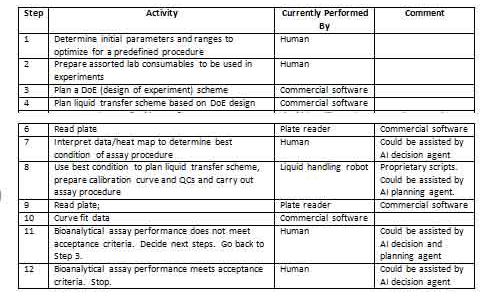 Table 1. Typical ligand binding assay PK assay development workflow utilizing DoE and potential AI enhancements
If all the above AI enhancements are implemented and integrated with peripheral instruments such as plate washer, plate sealer, incubator, plate reader and assorted commercial software, we would have a robot that takes human input on assay procedures and initial assay parameters, plans DoE experiments, executes the DoE experiment, interprets the data, decides on the best parameters, plans a bioanalytical run, executes the run, collects data and curve-fits data, decides whether the assay performance is acceptable or not, and if not, decides new parameters to repeat the process. This robot can work tirelessly day and night, until it reaches a satisfactory assay condition, or hits some boundary conditions set by humans, or runs out of lab consumables.
Conclusion
With the accelerated advancement of AI in the past few years, non-bench based bioanalytical work could see AI enhancement first. Intelligent robots that can assist bioanalysis and life sciences bench work in general are now technologically feasible in principle. The things these robots can achieve are endless.
However, current mainstream AI development effort focuses on mass AI applications such as smart search engines and self-driving cars. The business case for AI-empowered robotics for bioanalysis and life sciences as a whole is still incubating. As before, I strongly believe that it is only a matter of time before AI finally permeates into life sciences, with this kind of advanced robotics taking their place in every bioanalytical laboratory, freeing up bioanalytical scientists from much physical work and letting them focus on the sciences.
